

The Micro-Macro Identity: On Code-Switching Through Professional Cultures
How different organizational ecosystems shape not just our work, but who we become

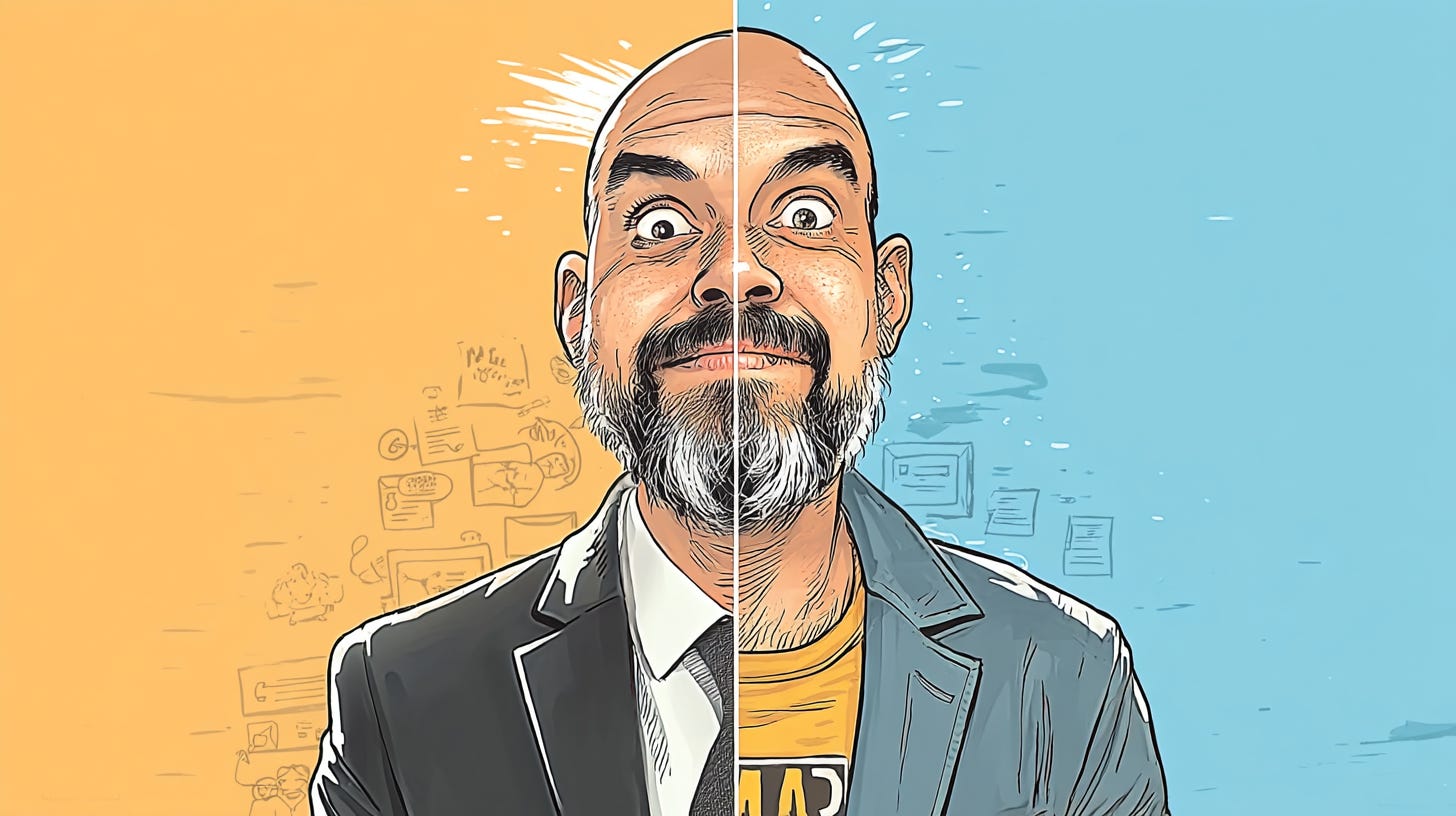
There's this moment of disorientation I experience when I walk from a startup's converted warehouse into a corporate headquarters on the same day. It's not just the aesthetic shift. Open laptops on communal tables versus reserved conference rooms with telepresence screens. It's something deeper, like crossing an invisible cultural boundary that requires a complete recalibration of who I am professionally.
I've spent the last eight years primarily embedded in startup culture, but my path here winds through over fifteen years of consulting or working for organizations of every scale, and early career experiences spanning everything from small companies to enterprise behemoths. What strikes me isn't just how different these environments are. It's how they've each demanded different versions of me to exist within them.
Let me tell you about something I've been wrestling with: how the micro and macro thinking patterns that define our design work are actually reflections of deeper cultural codes embedded in different organizational ecosystems. And how navigating between these worlds has taught me something unexpected about the fluidity of professional identity.
The Archaeology of Professional Selves
Working across organizational cultures has made me acutely aware of how environment shapes consciousness. In startup spaces, I find myself thinking like an ecosystem. Every design decision exists within a web of technical constraints, market pressures, and resource scarcity. There's no luxury of isolated thinking. When you're designing for a team of five people trying to build something that needs to exist in six weeks, every pixel carries the weight of business viability.
This isn't just about workflow or methodology. It's about fundamental rewiring of how I process problems. In startup mode, my brain runs multiple background threads simultaneously. User experience, development velocity, market timing, team capacity. I become someone who sees systems because survival depends on systems thinking. The macro lens isn't philosophical; it's existential.
But when I move into larger organizational contexts, something fascinating happens. A different cognitive architecture activates. I slow down. I consider edge cases with the kind of attention that would be paralyzing in a startup context. I become someone who cares deeply about design systems documentation, accessibility standards, and whether our animation curves follow mathematically consistent principles.
Both versions feel authentically me, which is the disorienting part. I'm not performing different roles. I'm literally becoming different people in response to different environmental pressures.
Cultural Code-Switching as Design Methodology
What I've come to understand is that these aren't just different approaches to the same work. They're different cultural operating systems that require fluency in entirely different value frameworks. Startup culture rewards velocity, iteration, and systems thinking out of necessity. Corporate culture rewards depth, consistency, and specialized expertise out of scale requirements.
The code-switching I do between these environments isn't just professional adaptation. It's a form of cultural translation. Like how bilingual speakers don't just change languages but shift entire cognitive patterns, I find myself shifting between what I think of as "macro cognition" and "micro cognition" based on the cultural context I'm operating within.
Growing up professionally, I learned to navigate multiple organizational spaces. Sometimes I belonged everywhere, sometimes I felt like an outsider in every room. The startup founder who questions why I'm overthinking a button state. The enterprise stakeholder who wonders why I'm not considering compliance implications. Each environment has its own language of belonging, its own markers of professional authenticity.
In startup environments, I think like a founder because functionally, that's what every role demands. There's no one else to consider whether our beautiful design concept can actually be built with our technical constraints, marketed with our budget, or supported with our team size. The macro perspective becomes survival equipment.
But here's where startup culture drives me crazy: the over-simplification of complex problems. Someone will say "make it mobile friendly" and expect me to nod and move forward. Mobile friendly how? Mobile-first responsive design? Progressive enhancement? Mobile compatible up to a point, then graceful degradation? Native app experience expectations on the web? Each approach has fundamentally different implications for development effort, user experience, and business outcomes.
In corporate environments, that same request would generate a requirements document, stakeholder alignment meetings, and technical specifications. Sometimes that feels like bureaucratic overkill, but it also means we're actually solving the right problem instead of building something based on assumptions.
In larger organizations, I encounter the luxury of specialization. Teams with the bandwidth to examine design decisions under microscopes I didn't know existed. This creates space for genuine micro-mastery, the kind of deep craft that produces elegant solutions to specific problems. But it also creates what I think of as "expertise silos." Brilliant specialists who've optimized for their domain without necessarily understanding systemic implications.
The Identity Crisis as Cultural Phenomenon
For years, this professional shape-shifting felt like evidence of some fundamental inconsistency in my design philosophy. Who was the "real" me? The designer who prioritizes getting functional solutions into users' hands quickly, or the one who spends days perfecting micro-interactions? Was I being authentic to some core design identity, or just adapting opportunistically to whatever environment rewarded me?
I remember sitting in my car between client meetings once, literally changing clothes to match the cultural expectations of different organizations. T-shirt and jeans to golf shirt and pleated khakis (on a casual day). But the wardrobe change was just the surface manifestation of something deeper. I was changing cognitive patterns, value systems, even the way I spoke about design problems.
This used to feel like professional fraud. Now I'm starting to think it's professional fluency.
Making this switch between personas isn't always easy for me. During a 360 review cycle at a startup I was working at, a peer told me I was a "model citizen." In that context, in that culture, it felt like an indictment. Model citizens don't disrupt. They don't challenge assumptions or push boundaries. They follow rules that startup culture supposedly exists to break. The feedback stung because it suggested I had over-corrected, that in trying to be professional and thoughtful, I had become something antithetical to the scrappy, question-everything ethos that startup environments claim to value.
But here's the thing: that same "model citizen" quality would be praised in a corporate environment. The thoughtfulness that felt like conformity in startup culture becomes strategic thinking in enterprise contexts. The careful consideration that seemed like analysis paralysis becomes due diligence. Same behaviors, completely different cultural interpretation.
The assumption that there should be one "authentic" version of ourselves across all contexts, that consistency equals integrity, might be a limitation rather than an ideal. What if professional identity, like cultural identity, is inherently fluid? What if the ability to code-switch between different organizational cultures isn't professional confusion but professional sophistication?
Interface Design as Identity Metaphor
I keep coming back to interface design as a metaphor for this experience. Good interfaces don't maintain rigid consistency. They adapt to context while preserving core functionality. A mobile interface isn't a "watered-down" version of a desktop interface; it's optimized for different constraints and opportunities. The underlying purpose remains constant, but the expression shifts based on environmental factors.
Maybe professional identity works similarly. The core purpose (creating meaningful experiences for humans) remains constant, but the expression necessarily shifts based on organizational constraints and opportunities. Startup Ben and Corporate Ben aren't different people; they're different interface adaptations of the same underlying system.
This reframing has been liberating. Instead of trying to maintain some artificial consistency across contexts, I've learned to read the cultural signals of each environment and adapt my approach while maintaining coherence around deeper principles.
Key Reflections on Professional Code-Switching
Identity is fluid, not fixed. Professional belonging is more than methodology. Personal narrative matters more than external frameworks.
What I've developed through this process is something I think of as "contextual design intelligence." The ability to understand not just what makes good design in abstract, but what makes effective design within specific cultural and organizational constraints.
This means sometimes shipping something that feels 70% finished because 70% finished and responsive to market feedback serves human needs better than 100% finished and irrelevant. But it also means recognizing when micro details are culturally critical. When that seemingly small interaction pattern is fundamental to user trust within a specific context, or when accessibility considerations are the difference between inclusion and exclusion for entire populations.
The skill isn't in having perfect judgment about when to focus on details versus systems. It's in developing frameworks for making those judgment calls quickly and iterating when you're wrong.
But let's be honest: finding the "right" level of good enough is often excruciating. It can take months or even years to calibrate what "good" design means within a specific organizational culture and user context. I've shipped things that felt 90% finished but were actually over-engineered for the problem we were solving. I've also shipped things that felt barely viable but turned out to be exactly what users needed at that moment. The calibration process is ongoing, contextual, and deeply uncomfortable for anyone with perfectionist tendencies.
The Personal Motto as Cultural Bridge
My "think in macro and micro" philosophy emerged from this navigation between cultural contexts. It wasn't originally meant as design advice. It was my attempt to create a bridge between the different professional identities these environments demanded.
What I've learned is that this isn't really about finding balance between competing priorities. It's about developing the cognitive agility to zoom between different scales of thinking while maintaining coherence around core human-centered principles.
When I tell teams to "think in macro and micro," I'm really asking them to develop fluency across different organizational cultures and design scales. Not because it's professionally advantageous, but because it more accurately reflects the complexity of human experience in our technological landscape.
The Future of Professional Identity
Working across organizational cultures has taught me that the future belongs to people who can resist false choices between different approaches, instead developing fluency across multiple contexts and scales of thinking. Not as professional opportunism, but as recognition that human experience doesn't exist within single organizational contexts.
Users don't experience our products through the lens of startup constraints or enterprise scalability. They experience our design decisions as continuous flows of interaction that either serve their needs or create friction, build trust or erode it, feel human or mechanical.
The ability to think simultaneously about immediate moments of interaction and broader systems of experience, this cognitive zoom I've developed across organizational cultures, feels increasingly essential. Not just as a design skill, but as a way of understanding how human experience actually works in our complex technological environment.
Sometimes I wonder if this professional shape-shifting is preparing me for something larger. Not just better design work, but a deeper understanding of how identity functions in an increasingly fluid world. How we construct belonging across contexts that demand different versions of ourselves.